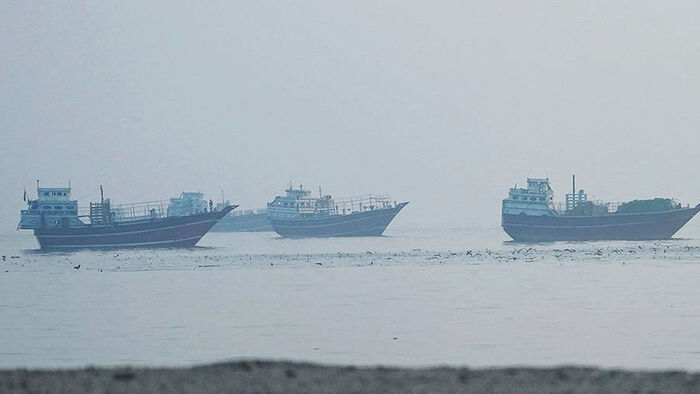
▲ Strait of Hormuz
The Strait of Hormuz, which had been blocked for four months, is set to reopen after the United States signed a memorandum of understanding with Iran to extend their truce by 60 days.
However, outlooks suggest that crude oil shipments passing through the waterway are unlikely to return to pre-war levels.
Foreign media outlets, including Bloomberg, reported on a related analysis by investment bank Goldman Sachs.
Goldman Sachs projected that even after the war ends, oil flows through the strait will only recover to about 70 percent of pre-war levels.
The report was even titled "70% of Pre-War Hormuz Flows Might Become the New 100%."
According to the International Energy Agency (IEA), about 20 million barrels of oil and products used to flow through the strait every day before the war.
In contrast, visible flows currently passing through the strait amount to only about 1.3 million barrels per day.
Even when adding the 1.6 million barrels per day from so-called "dark crossings" through the Gulf of Oman—where vessels turn off their geolocation devices—the total falls far short of pre-war levels.
For flows to fully normalize, an additional 13 million barrels per day must be restored.
However, Goldman Sachs assessed that a full recovery is virtually impossible.
The primary reason is that alternative bypass routes developed by oil-producing nations during the war have already taken hold.
Saudi Arabia's state-owned oil giant Aramco maximized the utilization rate of its East-West pipeline leading to the Red Sea port of Yanbu.
The United Arab Emirates (UAE) also actively utilized its pipeline connected to the port of Fujairah, which sits outside the Strait of Hormuz.
Iraq also diverted a significant portion of its export volumes to a pipeline heading to Turkey's port of Ceyhan.
The volume of crude oil exported through these bypass routes alone reaches 7.5 million barrels per day.
The major producers' "exodus from Hormuz" appears to be hardening into a structural shift rather than a temporary response.
In fact, earlier this month, the UAE officially announced plans to expand its ports along the Gulf of Oman and build new harbors.
The initiative is designed to completely eliminate its dependence on the Strait of Hormuz.
Thani Al Zeyoudi, the UAE's Minister of State for Foreign Trade, declared, "We're moving toward having zero Hormuz dependency, and that's regardless of whether it's open or not."
He added, "We will not stop the new plan" to secure alternative transport routes.
Even Kuwait, which lacks its own bypass pipeline, has entered negotiations through its state oil company to share facilities with Saudi Arabia and the UAE.
Goldman Sachs predicted that oil shipments would increase to some extent by the end of next month due to the truce agreement.
It also analyzed that crude oil production in the Gulf region is likely to show a recovery by October.
However, variables remain.
There is a significant possibility that operations to clear sea mines, which Iran may have laid during the war, will face difficulties.
Another obstacle is that Iran approved a draft bill in April to enforce vessel transit permits and collect tolls.
Goldman Sachs pointed out that some shipowners may still be reluctant to enter the strait due to safety concerns.
The 107-day war has left scars far deeper than mere physical damage.
Even the strategic status of the Strait of Hormuz, which once handled 20 percent of global oil shipments, is being shaken to its core.
Oil-producing nations, having experienced Iran's blockade of the strait, have diversified their transport routes, and this trend is expected to continue even after the war ends.
As experts predict, an era where "70% of pre-war flows becomes the new 100%" is fast approaching.
※ Please note: This article was translated by AI and may contain errors.